Advanced SNMP Trap Orchestration in Reliance SCADA: Engineering Secure Telemetry for Remote Water Pump Stations

Secure remote water telemetry using advanced SNMP trap orchestration in Reliance SCADA. Align your pump station monitoring with IEC 62443 and NIS2 standards.
The Fallacy of ‘Polling-Only’ Reliability in Critical water Infrastructure
In the world of Energy Grid Architecture and critical water management, a dangerous myth persists: that periodic polling is the only way to ensure data integrity in remote telemetry. Many engineers, wary of the complexities of asynchronous communication, default to high-frequency polling cycles that saturate bandwidth and increase the attack surface of Industrial Control Systems (ICS). As a pragmatic IEC 62443 auditor, I frequently encounter sites where 90% of network traffic is redundant status requests, while critical alarm latency remains dangerously high.
- Secure remote water telemetry using advanced SNMP trap orchestration in Reliance SCADA. Align your pump station monitoring with IEC 62443 and NIS2 standards.
- The Fallacy of ‘Polling-Only’ Reliability in Critical water Infrastructure
- Why SNMPv3 is Non-Negotiable for Remote Pump Stations
- Technical Comparison: Telemetry Methods for water Infrastructure
- Implementing Secure Trap Handling in Reliance SCADA
- Engineering for Resilience: The ‘Trap-and-Poll’ Hybrid Approach
- Conclusion: Auditing the Future of water SCADA
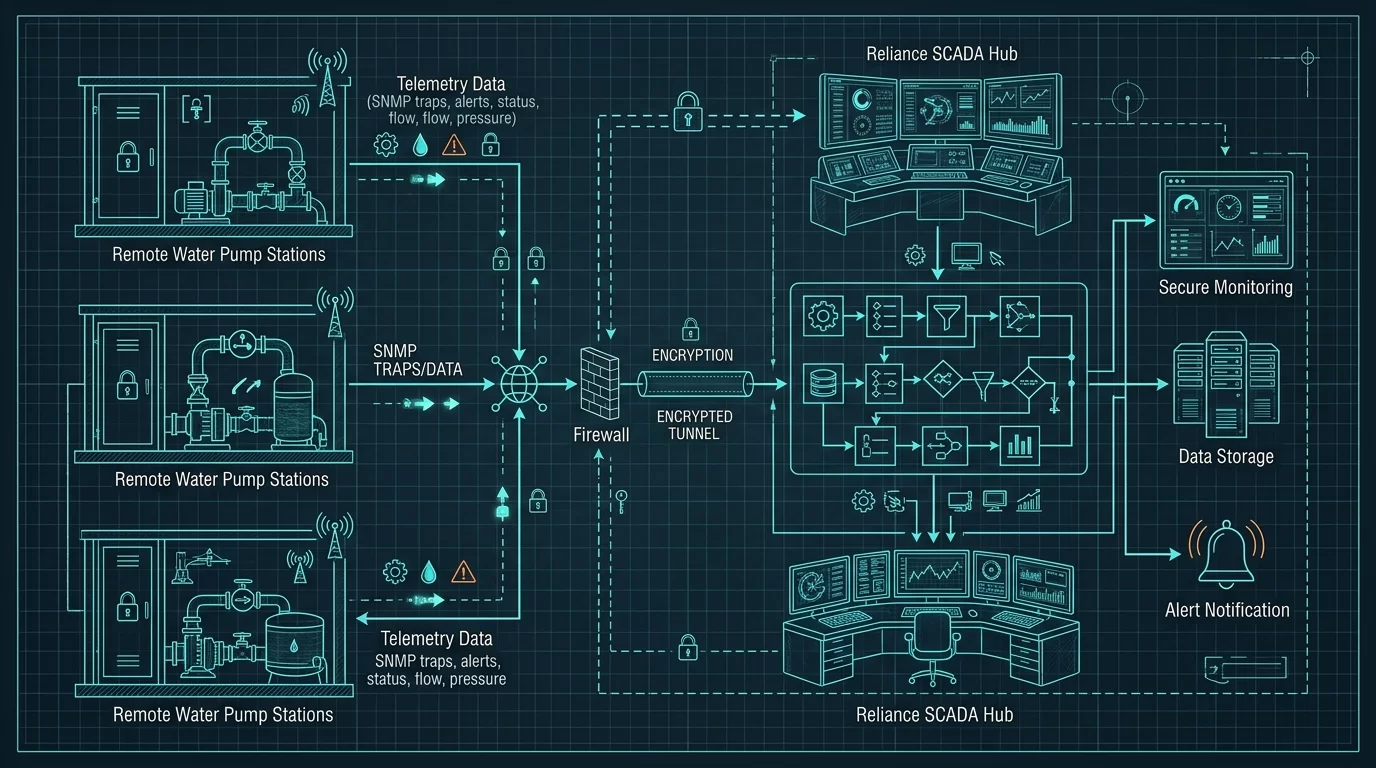
Advanced SNMP (Simple Network Management Protocol) Trap orchestration, particularly when integrated into the Reliance SCADA ecosystem, challenges this paradigm. By moving from a reactive polling model to an event-driven ‘Trap’ architecture, engineers can achieve sub-second notification of critical failures at remote pump stations without the overhead of constant polling. However, the myth that SNMP is ‘inherently insecure’ often prevents this optimization. This article breaks down how to engineer secure, authenticated, and encrypted telemetry that meets the rigorous demands of modern regulatory frameworks like NIS2 and IEC 62443-3-3.
Why SNMPv3 is Non-Negotiable for Remote Pump Stations
water pump stations are often geographically dispersed, relying on cellular backhaul or radio links with limited throughput. Traditional polling (Modbus over TCP or standard DNP3) can lead to ‘stale data’ if a poll cycle is missed due to jitter. SNMPv3 Traps, when properly orchestrated, provide an immediate push notification to the Reliance SCADA server the moment a setpoint is breached or a hardware fault occurs.
The security concerns associated with older SNMP versions (v1 and v2c) are valid; they rely on ‘community strings’ sent in cleartext. However, SNMPv3 introduces User-based Security Models (USM) providing authentication (HMAC-SHA) and encryption (AES). For an auditor, an unencrypted SNMPv1 string is a major non-conformity. A properly configured SNMPv3 trap receiver in Reliance SCADA is a robust security control.
Technical Comparison: Telemetry Methods for water Infrastructure
To understand the efficiency gains, let us compare the three primary methods of telemetry used in remote water distribution networks.
| Feature | Standard Polling (Modbus/TCP) | SNMPv2c Traps | SNMPv3 Orchestrated Traps |
|---|---|---|---|
| Bandwidth Efficiency | Low (Constant overhead) | High (Event-driven) | High (Event-driven) |
| Security (Confidentiality) | None (Cleartext) | None (Cleartext) | High (AES-256 Encryption) |
| Authentication | None/IP-based | Weak (Community String) | Strong (HMAC-SHA/SHA-2) |
| Latency | Variable (Poll-cycle dependent) | Near-Instant | Near-Instant |
Implementing Secure Trap Handling in Reliance SCADA
Reliance SCADA provides a flexible environment for handling SNMP traps through its communication drivers and script engine. To align with IEC 62443 requirements for integrity, your trap orchestration must include a ‘keep-alive’ or ‘heartbeat’ mechanism to ensure the remote station hasn’t gone silent due to a malicious actor or hardware failure.
Below is a conceptual example of a configuration logic for a secure SNMPv3 Trap listener. This configuration ensures that only traps from authorized EngineIDs are processed by the Reliance SCADA database.
# Example Net-SNMP Trapd Configuration for Reliance SCADA Integration
# Location: /etc/snmp/snmptrapd.conf

# 1. Define the Security User (Aligning with IEC 62443-4-2)
createUser -e 0x8000000001020304 scadaAdmin SHA "AuthPassword123" AES "PrivPassword456"

# 2. Authorize the user for trap processing
authCommunity log,execute,net public
authuser log,execute scadaAdmin priv

# 3. Forward to Reliance SCADA Internal Scripting Engine via Localhost
# This ensures the SCADA logic can parse the OID and trigger an alarm
tforward default 127.0.0.1:162
Engineering for Resilience: The ‘Trap-and-Poll’ Hybrid Approach
A pragmatic auditor knows that ‘Event-Driven’ does not mean ‘Set and Forget.’ The most secure architectures for remote water stations utilize a hybrid approach. While traps provide the immediate telemetry required for operational safety, a low-frequency ‘integrity poll’ (e.g., once every 30 minutes) should be used to synchronize the full device state and confirm the communication path is still valid. This satisfies the NIS2 requirement for ‘systemic resilience’ and ensures that if a trap is lost in transmission, the system eventually recovers.
Furthermore, when configuring Reliance SCADA, engineers must map specific OIDs (Object Identifiers) to internal tags with strict validation. For instance, a pump vibration alarm OID should be validated against a range; an out-of-bounds value could indicate a sensor malfunction or a ‘data injection’ attack, a scenario specifically addressed in Reliance SCADA documentation regarding secure driver configuration.
Conclusion: Auditing the Future of water SCADA
The transition to advanced SNMP trap orchestration is not merely a technical upgrade; it is a security necessity. By leveraging the encrypted capabilities of SNMPv3 within the Reliance SCADA framework, water utility operators can move away from the ‘noisy’ and insecure polling methods of the past. As an auditor, my recommendation is clear: discard the myth that SNMP is an antique. When engineered with modern encryption and integrated into a robust SCADA platform, it becomes the most efficient tool for securing the telemetry of our most vital resource.