The Ultimate Guide: Engineering Edge AI for Water Infrastructure—Evaluating Hardware Constraints in Corrosive and High-Humidity Environments

Discover how to engineer resilient Edge AI solutions for water infrastructure by overcoming hardware constraints in corrosive, high-humidity environments. This ultimate guide provides water infrastructure managers with data-driven hardware evaluation metrics, conformal coating strategies, and deployment architectures for seamless SCADA integration.
- Introduction: The Hostile Reality of water Infrastructure
- Case Study Context: Project Poseidon
- Evaluating Hardware Constraints and Environmental Stressors
- Hardware Evaluation Matrix
- Engineering the Edge-to-SCADA Architecture
- Edge AI Inference Script (Python)
- Deployment Best Practices and Secure Transmission
- Conclusion
Introduction: The Hostile Reality of water Infrastructure
As a Senior SCADA Architect, I frequently encounter a critical disconnect between data science teams and operational technology (OT) engineers: the physical reality of the deployment environment. water and wastewater infrastructure—spanning desalination plants, lift stations, and biological nutrient removal basins—presents one of the most hostile environments for standard IT hardware. Hydrogen sulfide (H2S), chlorine gas (Cl2), and sustained relative humidity (RH) exceeding 95% will systematically destroy unprotected silicon and copper traces within weeks.
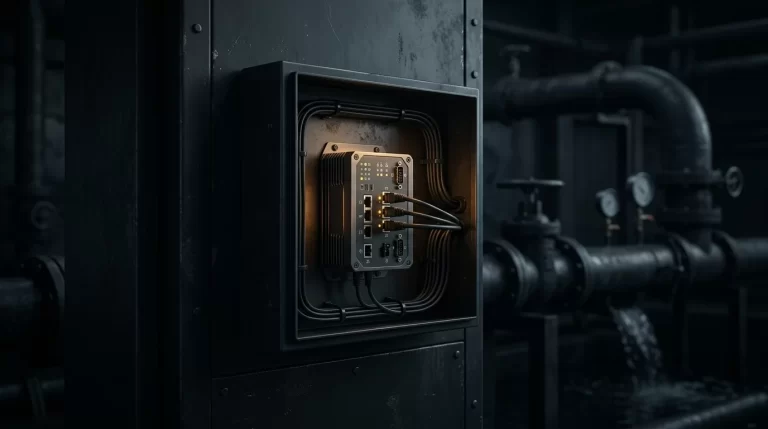
Deploying Edge Artificial Intelligence (Edge AI) for predictive maintenance or autonomous process control requires placing high-performance compute nodes directly at the process edge. However, high-performance computing generates heat, and traditional active cooling (fans) introduces corrosive ambient air directly over sensitive microprocessors. This guide serves as a deep-dive technical case study on engineering Edge AI hardware architectures capable of surviving these aggressive environments while maintaining deterministic SCADA integration.
Case Study Context: Project Poseidon
To illustrate these engineering principles, we will analyze “Project Poseidon,” a recent initiative aimed at deploying Edge AI for real-time vibration anomaly detection on 500HP centrifugal pumps at a regional wastewater treatment facility. The primary objective was to process high-frequency vibration data locally, utilizing a quantized neural network to detect cavitation and bearing degradation, and subsequently transmit lightweight anomaly scores to the central SCADA system.
The environmental baseline at the pump gallery was severe: ambient temperatures fluctuating between -5°C and 45°C, relative humidity consistently at 98%, and atmospheric H2S concentrations peaking at 15 ppm. Standard commercial-off-the-shelf (COTS) gateways failed within 45 days due to dendritic growth and copper sulfide corrosion on the printed circuit boards (PCBs).
Evaluating Hardware Constraints and Environmental Stressors
When architecting Edge AI for water infrastructure, hardware selection must be dictated by three primary environmental stressors:
- Chemical Corrosion (H2S and Cl2): Hydrogen sulfide reacts rapidly with copper and silver components, forming conductive sulfide creep that causes micro-shorts. Conformal coating is not optional; it is mandatory. Parylene (Type XY) offers the highest resistance to H2S due to its pinhole-free vapor deposition process, outperforming standard acrylic (Type AR) or silicone (Type SR) coatings.
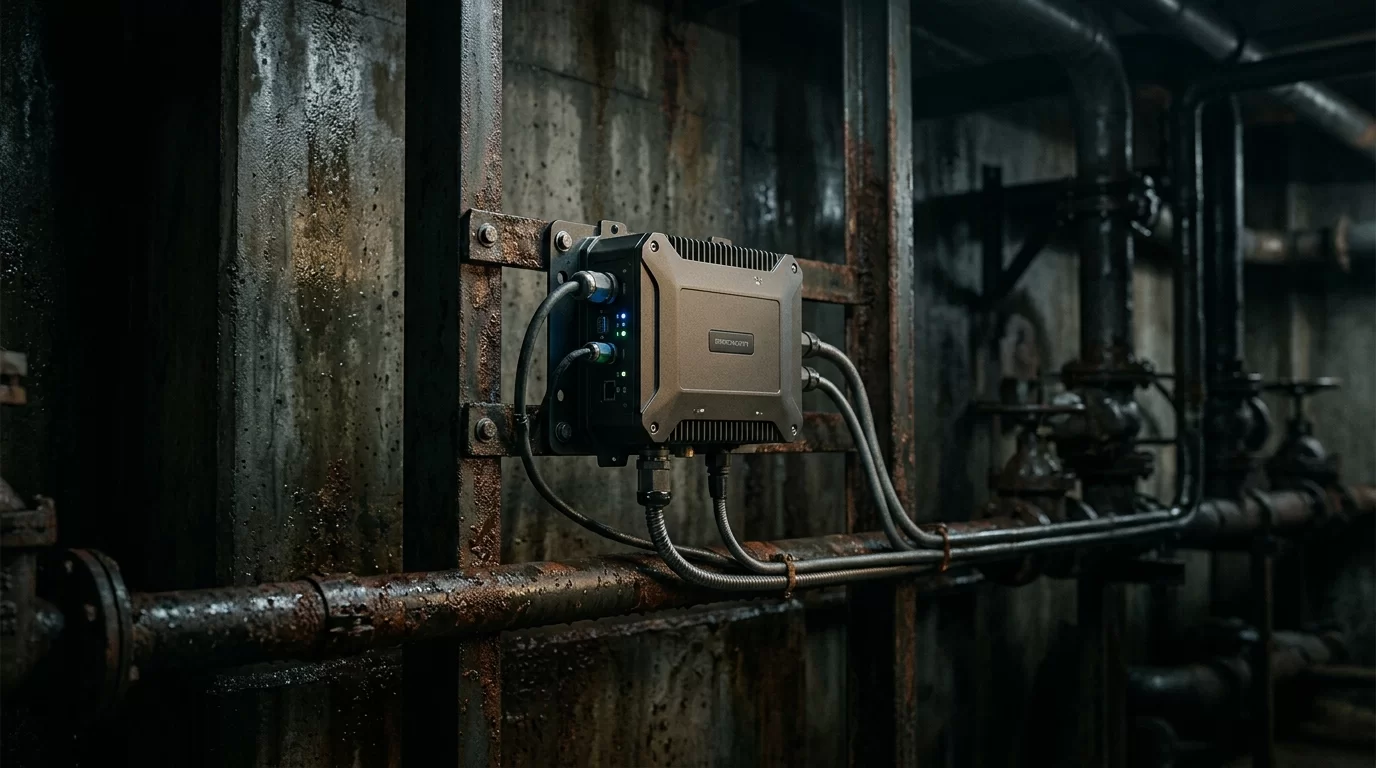
- High Humidity and Condensation: Thermal cycling in humid environments leads to condensation inside enclosures. Edge nodes must be housed in IP67 or NEMA 4X rated enclosures, utilizing Gore-Tex breather valves to equalize pressure while blocking moisture ingress.
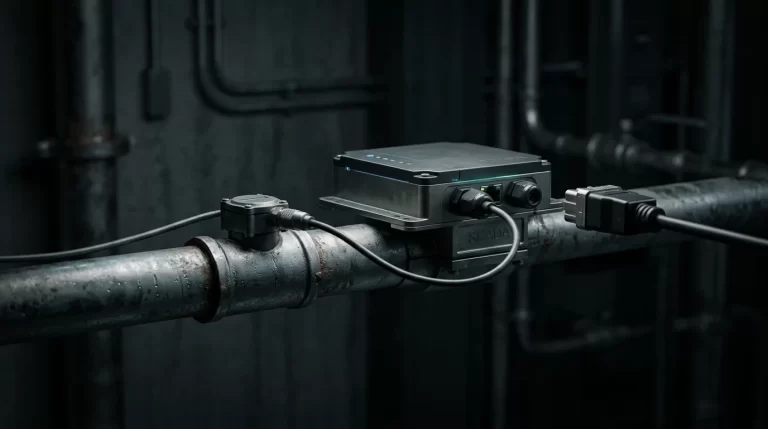
- Thermal Management: AI accelerators (such as NVIDIA Jetson or Google Coral TPUs) generate significant thermal loads. Because fanless, sealed enclosures are required to block corrosive gases, thermal dissipation must rely entirely on conductive cooling through heavily finned, extruded aluminum chassis.
Hardware Evaluation Matrix
The following table outlines the data-driven evaluation of three hardware tiers considered for Project Poseidon. The selection criteria heavily weighted Mean Time Between Failures (MTBF) under corrosive conditions over raw compute power.
| Hardware Tier | Enclosure Rating | Thermal Design | Conformal Coating | AI Compute Capacity | Est. MTBF (in 15ppm H2S) | Capex per Node |
|---|---|---|---|---|---|---|
| Standard Industrial PC (IPC) | IP40 | Active (Fan) | None | High (Discrete GPU) | < 2 Months | $1,200 |
| Ruggedized Edge Gateway | IP65 | Passive (Fanless) | Acrylic (Type AR) | Medium (Integrated NPU) | 12 – 18 Months | $2,500 |
| Custom IP67 AI Node | IP67 / NEMA 4X | Passive (Extruded Chassis) | Parylene (Type XY) | Medium (Edge TPU) | > 5 Years | $4,800 |
Ultimately, the Custom IP67 AI Node was selected. While the initial CapEx was higher, the operational expenditure (OpEx) savings from avoiding bi-monthly hardware replacements and SCADA downtime yielded a positive ROI within 14 months.
Engineering the Edge-to-SCADA Architecture
Hardware resilience is only half the equation; the Edge AI node must seamlessly integrate with legacy PLC networks and the enterprise SCADA. In Project Poseidon, the Edge node needed to ingest raw analog data from non-standard piezoelectric vibration sensors.
Because these sensors utilized proprietary serial protocols, integrating non-standard vibration sensors requires robust localized parsing. For a deep dive into engineering the software layer for this ingestion, see our guide on Developing High-Performance C# Data Parsers for Non-Standard IoT Sensors in water SCADA Systems.
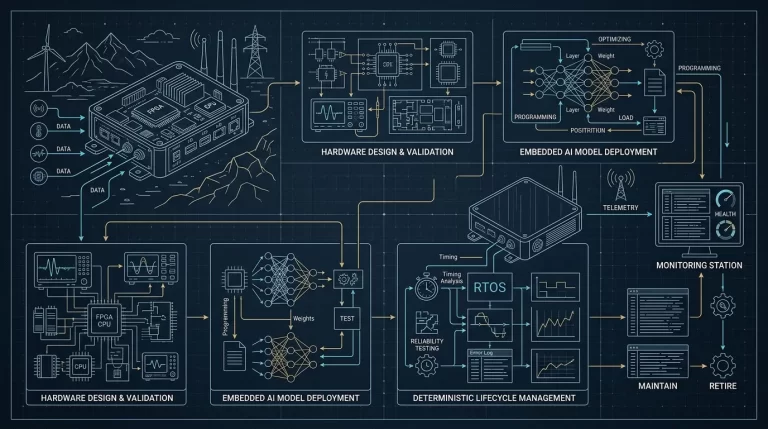
Once the data is parsed, the Edge AI model processes the high-frequency telemetry locally. Instead of flooding the SCADA network with gigabytes of raw vibration data, the node executes a quantized ONNX model to generate a simple “Anomaly Score” (0.0 to 1.0). This dramatically reduces bandwidth requirements.
Edge AI Inference Script (Python)
Below is a sanitized, production-grade Python implementation running on the Edge AI node. It ingests local sensor data, runs the inference model, and publishes the anomaly score to the SCADA MQTT broker.
import paho.mqtt.client as mqtt
import numpy as np
import onnxruntime as ort
import time
import json

# SCADA MQTT Broker Configuration (Internal OT Network)
BROKER = "10.0.50.12"
PORT = 1883
TOPIC_PUB = "scada/edge/pump_03/anomaly"

# Load quantized Edge AI model for vibration analysis (Optimized for Edge TPU/CPU)
session = ort.InferenceSession("/opt/models/vibration_anomaly_quantized.onnx")

def read_vibration_sensor():
    # Simulated high-frequency vibration data ingestion from local PLC/Sensor
    # In production, this interfaces with the C# parser via local socket or shared memory
    return np.random.normal(0.02, 0.005, (1, 128)).astype(np.float32)

def on_connect(client, userdata, flags, rc):
    print(f"Connected to SCADA MQTT broker with result code {rc}")

client = mqtt.Client(client_id="EdgeNode_WWTP_01")
client.on_connect = on_connect
client.connect(BROKER, PORT, 60)
client.loop_start()

try:
    while True:
        # 1. Ingest High-Frequency Data
        sensor_data = read_vibration_sensor()

        # 2. Execute Edge AI Inference
        inputs = {session.get_inputs()[0].name: sensor_data}
        prediction = session.run(None, inputs)[0]
        anomaly_score = float(prediction[0][0])

        # 3. Thresholding and SCADA Publishing
        if anomaly_score > 0.85:
            payload = {
                "timestamp": int(time.time()),
                "asset_id": "PUMP_03",
                "anomaly_score": round(anomaly_score, 4),
                "status": "CRITICAL_WARNING",
                "environment_rh": 98.2 # Diagnostic tracking of enclosure humidity
            }
            # Publish QoS 1 to ensure delivery to SCADA
            client.publish(TOPIC_PUB, json.dumps(payload), qos=1)
            print(f"[ALERT] Anomaly detected! Score: {anomaly_score}")

        # 1 Hz sampling rate for Edge processing loop
        time.sleep(1)
except KeyboardInterrupt:
    client.loop_stop()
    client.disconnect()
Deployment Best Practices and Secure Transmission
Once the Edge AI hardware is physically secured and the inference logic is running, the final architectural constraint is secure data transmission. water infrastructure is classified as critical infrastructure, meaning any node placed at the edge expands the cybersecurity attack surface.
For remote pump stations or distributed reservoirs, transmitting this critical AI inference data back to the central SCADA requires secure tunneling. We highly recommend reviewing our comprehensive methodology on Configuring Secure DNP3 Over VPNs for Remote Renewable-Powered water Infrastructure Sites to ensure that your Edge AI telemetry is encapsulated within AES-256 encrypted tunnels.
Furthermore, physical deployment should adhere to strict OT guidelines. Always install Edge AI nodes with a dedicated 24VDC industrial power supply equipped with surge protection, as power fluctuations from heavy pump motors starting and stopping can corrupt the solid-state drives (SSDs) hosting the AI models. Inside the NEMA 4X enclosure, utilize industrial-grade desiccant packets with visual indicators, and establish a preventative maintenance schedule to replace them semi-annually.
Conclusion
Engineering Edge AI for water infrastructure is fundamentally an exercise in mitigating hardware constraints. By prioritizing Parylene conformal coatings, fanless thermal extrusion, and IP67 sealed enclosures, water Infrastructure Managers can deploy advanced predictive analytics directly into highly corrosive, high-humidity environments. When combined with optimized, localized inference models and secure SCADA integration protocols, these resilient edge architectures transition from fragile IT experiments to mission-critical OT assets, ultimately reducing unexpected downtime and extending the lifecycle of multi-million dollar hydraulic assets.