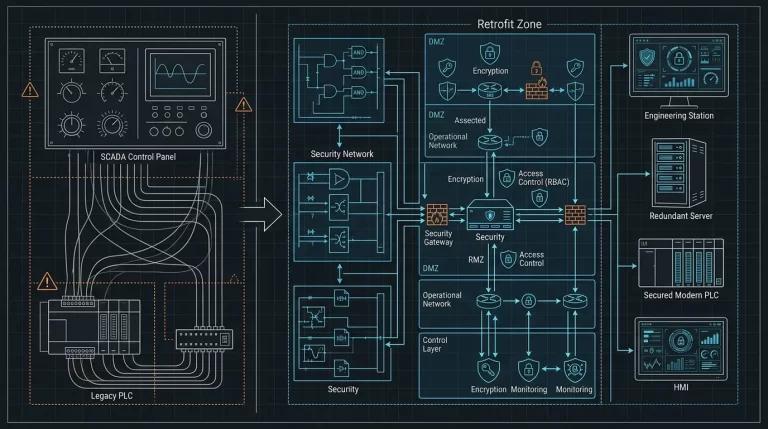
The Ultimate Guide: Architecting Secure IT/OT Convergence for IIoT-Enabled Energy Grids


Master the complexities of IT/OT convergence in energy grids with this expert-level guide to IEC 62443 compliance and secure IIoT integration. Learn how to architect resilient, cyber-secure infrastructures that bridge the gap between legacy SCADA systems and modern cloud-based analytics.
- Introduction: The Convergence Dilemma
- Step 1: Establishing Visibility and Asset Inventory (IEC 62443-2-1)
- Step 2: Logical Segmentation and the Evolution of the Purdue Model
- Step 3: Hardening the IIoT Edge Gateway
- Step 4: Implementing Zero Trust via the IDMZ
- Step 5: Identity and Access Management (IAM) for OT
- Step 6: Continuous Monitoring and Threat Hunting
- Conclusion
Introduction: The Convergence Dilemma
For the modern Energy Grid Architect, the convergence of Information Technology (IT) and Operational Technology (OT) is no longer a choice—it is a prerequisite for the Industrial Internet of Things (IIoT). However, this bridging of worlds introduces significant vulnerabilities. Legacy protocols like Modbus or DNP3, originally designed for isolated serial networks, are now exposed to routable IP networks. As a pragmatic auditor, I see the same mistakes repeatedly: treating OT security as an extension of IT security. This guide provides a rigorous, IEC 62443-compliant framework for architecting a secure energy grid.
Step 1: Establishing Visibility and Asset Inventory (IEC 62443-2-1)
You cannot secure what you cannot see. The first step in any technical implementation is the creation of a dynamic asset inventory. In an IIoT-enabled grid, this includes everything from HV/MV substations to edge gateways and smart meters. Unlike IT assets, OT assets often lack agents. Therefore, implementation must rely on Passive Network Monitoring (PNM).
- Implementation: Deploy SPAN/Mirror ports at the Level 2 (Cell/Area) and Level 3 (Site Operations) switches.
- Troubleshooting: If your asset discovery tool is missing devices, verify that the VLAN tagging (802.1Q) is correctly handled by the mirror port configuration.
Step 2: Logical Segmentation and the Evolution of the Purdue Model
The traditional Purdue Model is evolving. While the hierarchy remains, the integration of IIoT requires a more fluid yet secure approach. We must implement Security Zones and Conduits as defined in IEC 62443-3-3. The goal is to ensure that a compromise in the corporate network (Level 4/5) cannot propagate to the process control zone (Level 1/0).
| Feature | IT Security (Enterprise) | OT Security (Energy Grid) |
|---|---|---|
| Primary Goal | Confidentiality (Data Protection) | Availability & Safety (Process Continuity) |
| Protocol Landscape | HTTP, TLS, DNS, SMTP (Standardized) | Modbus, DNP3, IEC 61850, MQTT (Proprietary/Legacy) |
| Patch Management | Frequent, Automated, Low-Risk | Infrequent, Manual, High-Risk (Requires Downtime) |
| Communication Pattern | Dynamic, Peer-to-Peer, Internet-bound | Deterministic, Static, Master-Slave/Pub-Sub |
Step 3: Hardening the IIoT Edge Gateway
The Edge Gateway is the most critical point of failure in IT/OT convergence. It acts as the protocol translator between the field (Modbus/DNP3) and the cloud (MQTT/HTTPS). To secure this, you must implement Deep Packet Inspection (DPI) and payload validation. Below is a Python-based conceptual example of how a secure gateway should validate Modbus write requests against a whitelist before forwarding them to the PLC.
import logging
from pymodbus.client import ModbusTcpClient

# Configuration: Whitelist of allowed registers for writing
ALLOWED_WRITE_REGISTERS = [1001, 1002, 1005]

def secure_modbus_write(client, address, value):
    """
    Validates the register address against a security whitelist
    before executing a write command.
    """
    if address not in ALLOWED_WRITE_REGISTERS:
        logging.error(f"SECURITY ALERT: Unauthorized write attempt at address {address}")
        return False

    try:
        response = client.write_register(address, value)
        if response.isError():
            logging.error("Modbus Error: Could not write to register.")
            return False
        logging.info(f"Success: Register {address} updated to {value}.")
        return True
    except Exception as e:
        logging.critical(f"System Failure: {e}")
        return False

# Example Usage
client = ModbusTcpClient('192.168.10.50')
secure_modbus_write(client, 1001, 255) # Allowed
secure_modbus_write(client, 9999, 1)   # Blocked and Logged
Step 4: Implementing Zero Trust via the IDMZ
Never connect OT directly to IT. Use an Industrial Demilitarized Zone (IDMZ). This intermediate layer should host jump servers, patch management servers (WSUS), and data historians. All traffic must terminate in the IDMZ. For instance, a data historian in the OT zone should push data to a mirror historian in the IDMZ, which the IT side then queries. This ensures no direct socket connection exists between a corporate workstation and a protection relay.
Step 5: Identity and Access Management (IAM) for OT
Standard IT MFA (Multi-Factor Authentication) can be dangerous in OT environments if the authentication server is cloud-based and the internet connection drops. For grid resilience, implement Local MFA for critical control actions. Use Role-Based Access Control (RBAC) to ensure that a maintenance engineer has different permissions than a grid operator. Ensure that all administrative access is funneled through a Privileged Access Management (PAM) solution located in the IDMZ, providing full session recording and auditing.
Step 6: Continuous Monitoring and Threat Hunting
The final step is moving from reactive to proactive security. Implement an Industrial IDS (Intrusion Detection System) that understands industrial protocol semantics. If a DNP3 ‘Cold Restart’ command is issued during peak load hours, the system should trigger an immediate alert. This requires integrating OT security events into a centralized Security Operations Center (SOC), but with a dedicated OT-specific playbook to avoid accidental shutdowns during incident response.
Conclusion
Architecting a secure IIoT-enabled energy grid is a continuous process of balancing operational availability with cyber resilience. By following the IEC 62443 framework—focusing on segmentation, edge hardening, and strict access control—architects can build a system that not only withstands modern threats but also enables the data-driven future of the energy sector. Pragmatism in security is not about blocking all traffic; it is about ensuring that every bit that moves across the wire is verified, authorized, and safe.