Step-by-Step: Implementing Zero-Trust Architecture for Secure IT/OT Bridging in Municipal Utilities

The Architect’s Blueprint: Implementing Zero-Trust for Municipal IT/OT Convergence
Learn how to architect a robust Zero-Trust framework for municipal SCADA systems, ensuring secure IT/OT bridging through identity-based micro-segmentation and continuous verification. This guide provides a technical roadmap for industrial software developers to mitigate lateral movement risks in critical utility infrastructure.
- The Architect’s Blueprint: Implementing Zero-Trust for Municipal IT/OT Convergence
- The Shift: Traditional Perimeter vs. Zero-Trust Architecture
- Step 1: Establishing Identity as the New Perimeter
- Step 2: Micro-segmentation and the Software-Defined Perimeter
- Step 3: Implementing a Policy Enforcement Point (PEP)
- Technical Pitfalls: Latency and Protocol Incompatibility
- Continuous Monitoring and Behavioral Analytics
- Conclusion
As a Senior SCADA Architect, I have observed a dangerous trend: the reliance on the “air-gap” myth. Modern municipal utilities—water, wastewater, and energy—require real-time data for Hydraulic Modeling and billing, necessitating a bridge between the Operations Technology (OT) and Information Technology (IT) layers. Traditional perimeter-based security is no longer sufficient. We must transition to Zero-Trust Architecture (ZTA), where the default posture is “never trust, always verify,” regardless of whether the request originates from inside or outside the network.
The Shift: Traditional Perimeter vs. Zero-Trust Architecture
In the legacy model, once a user bypassed the VPN or firewall, they had broad access to the internal network. In a ZTA model, access is granted on a per-session, per-asset basis. For industrial developers, this means moving away from IP-based trust to identity-based trust.
| Security Metric | Traditional Perimeter (VPN/Firewall) | Zero-Trust Architecture (ZTA) | Impact on Municipal SCADA |
|---|---|---|---|
| Trust Assumption | Implicit trust for internal actors. | Zero implicit trust; verify every request. | Eliminates lateral movement from IT to OT. |
| Access Granularity | Network-level (VLAN/Subnet). | Resource-level (Application/Tag). | Prevents unauthorized access to PLC registers. |
| Visibility | Logged at the edge. | Full visibility into every transaction. | Critical for forensic auditing in regulated utilities. |
| Performance Impact | Low (Initial handshake only). | Moderate (Continuous authentication). | Requires optimized Policy Decision Points (PDP). |
Step 1: Establishing Identity as the New Perimeter
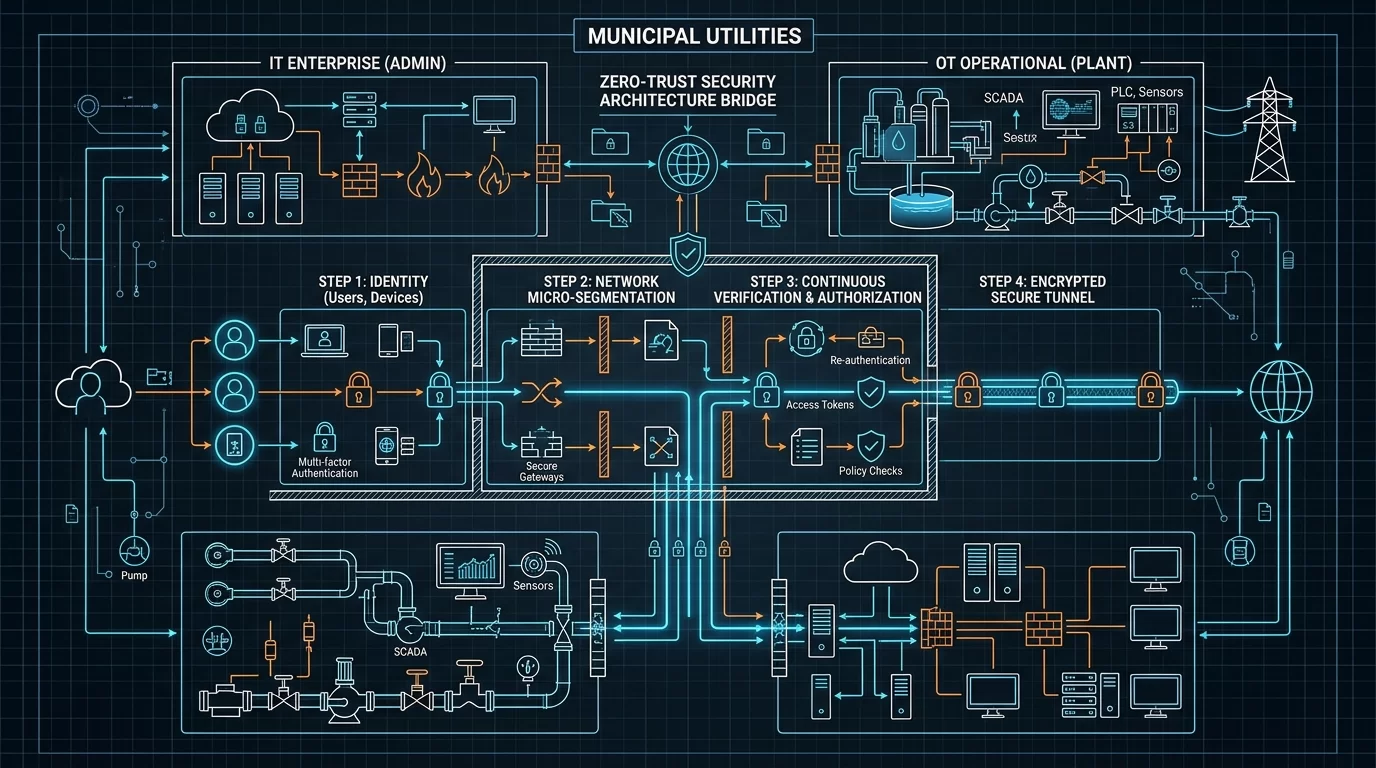
For industrial software developers, the first step is implementing a centralized Identity and Access Management (IAM) system that supports Multi-Factor Authentication (MFA) and OAuth2/OpenID Connect. However, standard MFA often fails in OT environments due to connectivity issues. Developers must implement hardware-based tokens (e.g., FIDO2 keys) or certificate-based authentication (mTLS) for machine-to-machine (M2M) communication between the SCADA server and field gateways.
Step 2: Micro-segmentation and the Software-Defined Perimeter
Micro-segmentation involves breaking the OT network into granular zones. In a municipal water plant, the high-lift pump station should not be able to communicate with the chemical dosing system unless explicitly required. Developers should leverage Software-Defined Networking (SDN) to create dynamic tunnels that exist only for the duration of the data exchange.
Step 3: Implementing a Policy Enforcement Point (PEP)
The core of ZTA is the Policy Decision Point (PDP) and the Policy Enforcement Point (PEP). Every request from an HMI to a PLC must be intercepted and validated against a central policy. Below is a Python-based logic snippet demonstrating how a developer might implement a simplified PEP for a SCADA gateway using JWT (JSON Web Tokens) for identity verification.
import jwt
import datetime

# Configuration for the Policy Decision Point (PDP)
SECRET_KEY = "scada_secure_key_2024"
ALLOWED_ROLES = ["operator", "engineer"]

def validate_request(token, resource_id, action):
    try:
        # Decode and verify the identity token
        payload = jwt.decode(token, SECRET_KEY, algorithms=["HS256"])
        user_role = payload.get("role")

        # Context-aware policy check
        if user_role not in ALLOWED_ROLES:
            return {"status": "DENIED", "reason": "Unauthorized Role"}

        # Check if the action is permitted for the specific asset
        # In a real scenario, this would query an OPA (Open Policy Agent) engine
        if action == "write" and user_role != "engineer":
            return {"status": "DENIED", "reason": "Write access restricted to Engineers"}

        return {"status": "GRANTED", "user": payload.get("sub")}

    except jwt.ExpiredSignatureError:
        return {"status": "DENIED", "reason": "Token Expired"}
    except jwt.InvalidTokenError:
        return {"status": "DENIED", "reason": "Invalid Identity"}

# Example Usage
sample_token = jwt.encode({"sub": "user_123", "role": "operator", "exp": datetime.datetime.utcnow() + datetime.timedelta(minutes=30)}, SECRET_KEY)
print(validate_request(sample_token, "PLC_PUMP_01", "write"))
Technical Pitfalls: Latency and Protocol Incompatibility
While ZTA significantly improves security, it introduces technical debt if not managed correctly. Two primary pitfalls exist:
- Protocol Overhead: Encapsulating legacy protocols like Modbus TCP or DNP3 inside encrypted mTLS tunnels can increase packet size and latency. In high-speed control loops (e.g., sub-10ms), this can cause jitter. Use hardware-accelerated encryption at the Edge Gateway level to mitigate this.
- The “Ghost” Asset Problem: Legacy PLCs often lack the compute power to handle modern authentication. Developers must use “ZTA Proxy” devices that sit in front of these legacy assets to handle the security handshake.
Continuous Monitoring and Behavioral Analytics
Zero-Trust is not a “set and forget” implementation. It requires continuous monitoring of the IT/OT bridge. By analyzing traffic patterns, developers can establish a baseline for normal operations. If a SCADA workstation suddenly attempts to scan the network using Nmap, the ZTA engine should automatically revoke its identity token and isolate the segment. This is where AI-driven anomaly detection becomes a force multiplier for municipal security teams.
Conclusion
Transitioning to a Zero-Trust Architecture in municipal utilities is a complex but necessary evolution. For industrial software developers, the focus must be on robust identity management, granular micro-segmentation, and the implementation of intelligent Policy Enforcement Points. By moving away from the brittle perimeter model, we ensure that our critical infrastructure remains resilient against the evolving threat landscape of the 21st century.