Retrofitting IEC 62443-3-3 Compliance for Legacy Reliance SCADA: A Technical Blueprint for Implementing Advanced Compensating Controls

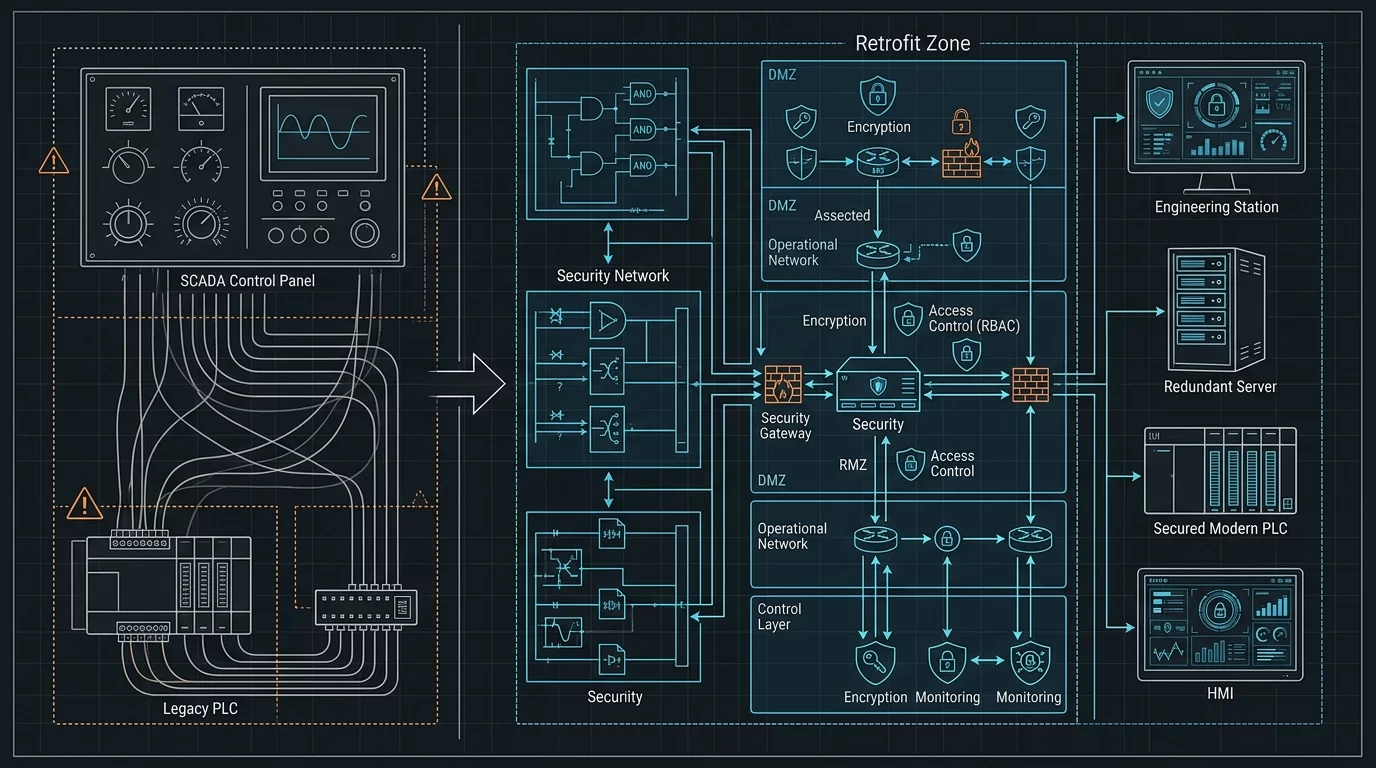
Retrofit legacy Reliance SCADA systems to meet IEC 62443-3-3 standards using advanced compensating controls and robust network segmentation strategies.
- The Legacy Dilemma in Modern Industrial Infrastructure
- Understanding the IEC 62443-3-3 Framework
- The Technical Constraints of Reliance SCADA
- Gap Analysis: Mapping Legacy Realities to IEC 62443-3-3
- The Technical Blueprint for Retrofitting
- Step 1: Implementing Zones and Conduits (SR 5.1)
- Step 2: Protocol Sanitization and DPI
- Step 3: Identity-Aware Proxying and MFA (SR 1.1)
- Step 4: Secure Remote Access and NERC CIP Compliance
- Conclusion: Pragmatic Compliance
The Legacy Dilemma in Modern Industrial Infrastructure
In the current landscape of industrial Automation, many operators across North America and Europe find themselves tethered to legacy Reliance SCADA systems. These systems, while providing decades of reliable service, were engineered in an era where ‘security by obscurity’ was the prevailing mindset. Today, with the implementation of the NIS2 Directive in the European Union and the stringent NERC CIP requirements in North America, these ‘insecure-by-design’ systems represent a significant compliance and operational risk. The challenge for Senior SCADA Engineers is not simply to replace these systems—an undertaking that often involves prohibitive costs and unacceptable downtime—but to retrofit them with a security architecture that meets the IEC 62443-3-3 (System Security Requirements and Security Levels) standard.
Understanding the IEC 62443-3-3 Framework
The IEC 62443-3-3 standard defines specific technical requirements for Industrial Automation and Control Systems (IACS). It is organized into seven Foundational Requirements (FRs), ranging from Identification and Authentication Control (FR 1) to Resource Availability (FR 7). For a legacy Reliance SCADA environment, achieving a target Security Level (SL-T) of 2 or 3 typically requires the implementation of ‘compensating controls.’ These are measures that provide equivalent security when the primary asset (the SCADA software or PLC) cannot natively perform a security function, such as encrypting traffic or enforcing Multi-Factor Authentication (MFA).
The Technical Constraints of Reliance SCADA
Legacy Reliance SCADA platforms often rely on outdated communication protocols and lack granular user permission structures. Common technical hurdles include:
- Lack of Encryption: Communication between the HMI, the SCADA server, and the PLCs is often cleartext, making it vulnerable to man-in-the-middle (MITM) attacks.
- Weak Authentication: Many legacy systems use hardcoded credentials or lack support for modern directory services like LDAP/Active Directory.
- Insufficient Logging: Audit trails are often non-existent or easily manipulated by an attacker with local access.
Gap Analysis: Mapping Legacy Realities to IEC 62443-3-3
To move toward compliance, engineers must perform a gap analysis. The following table illustrates how common legacy deficiencies are addressed through specific compensating controls:
| IEC 62443-3-3 Requirement | Legacy Limitation | Compensating Control Strategy |
|---|---|---|
| SR 1.1 (Human User Identification) | Shared accounts and weak passwords. | Identity-Aware Proxy (IAP) with MFA at the Zone perimeter. |
| SR 3.1 (Communication Integrity) | Cleartext protocols (e.g., Modbus/TCP). | IPsec Tunnels or MACsec between network switches. |
| SR 5.1 (Network Segmentation) | Flat network architecture. | Implementation of Zones and Conduits via Industrial Firewalls. |
| SR 6.1 (Audit Logs) | No centralized or secure logging. | Syslog export to a write-once-read-many (WORM) SIEM. |
The Technical Blueprint for Retrofitting
Step 1: Implementing Zones and Conduits (SR 5.1)
The cornerstone of any IEC 62443 retrofit is the ‘Zones and Conduits’ model. By segmenting the legacy Reliance SCADA environment into distinct security zones, you limit the ‘blast radius’ of a potential breach. A dedicated Industrial Firewall should act as the gateway (the conduit) between the Enterprise IT network and the SCADA OT network. This firewall must perform Deep Packet Inspection (DPI) to ensure that only valid industrial protocol commands are traversing the network.
Step 2: Protocol Sanitization and DPI
Since legacy PLCs often cannot validate the commands they receive, the network infrastructure must do it for them. Using an Intrusion Prevention System (IPS) or a specialized industrial firewall, you can create rules that permit ‘Read’ commands but block ‘Write’ or ‘Function Code 90’ (firmware update) commands from unauthorized hosts. Below is an example of a Snort-based rule designed to monitor and alert on unauthorized Modbus write attempts to a legacy PLC:
# Snort Rule for detecting unauthorized Modbus Function Code 15 (Write Multiple Coils)
alert tcp $EXTERNAL_NET any -> $PLC_NET 502 (msg:"SCADA_ALERT: Unauthorized Modbus Write Detected"; content:"|0f|"; offset:7; depth:1; sid:1000001; rev:1;)

# Cisco ASA ACL to restrict HMI access to specific PLC addresses
access-list SCADA_ZONE_ACL extended permit tcp host 192.168.10.50 host 192.168.20.10 eq 502
access-list SCADA_ZONE_ACL extended deny ip any any
Step 3: Identity-Aware Proxying and MFA (SR 1.1)
To satisfy SR 1.1 without modifying the legacy Reliance SCADA code, engineers should deploy an Identity-Aware Proxy (IAP). When a user attempts to access the SCADA HMI, the IAP intercepts the request and requires the user to authenticate via a modern identity provider (IdP) using MFA (e.g., Duo, Okta). Only after successful authentication is the user granted a temporary, encrypted session to the legacy interface.
Step 4: Secure Remote Access and NERC CIP Compliance
For North American utilities, NERC CIP-005 (Electronic Security Perimeters) requires strict control over remote access. A ‘Jump Host’ or ‘Secure Access Provider’ should be used. This host acts as a middleman, ensuring that no direct RDP or VNC connection is ever made from the internet to the Reliance SCADA server. All sessions should be recorded and audited to meet the requirements of IEC 62443-3-3 SR 6.2.
Conclusion: Pragmatic Compliance
Retrofitting a legacy Reliance SCADA system for IEC 62443-3-3 compliance is a complex engineering task that requires a shift from ‘host-based security’ to ‘network-centric security.’ By leveraging industrial firewalls, DPI, and identity proxies, Senior SCADA Engineers can extend the life of their existing assets while meeting the rigorous demands of ISA/IEC 62443 and regional regulations like NERC CIP. In the era of NIS2, compliance is no longer optional; it is the foundation of operational resilience.