The Ultimate Guide: Hardening Distributed VPP Control Architectures for NIS2 Technical Compliance and OT Cyber Resilience

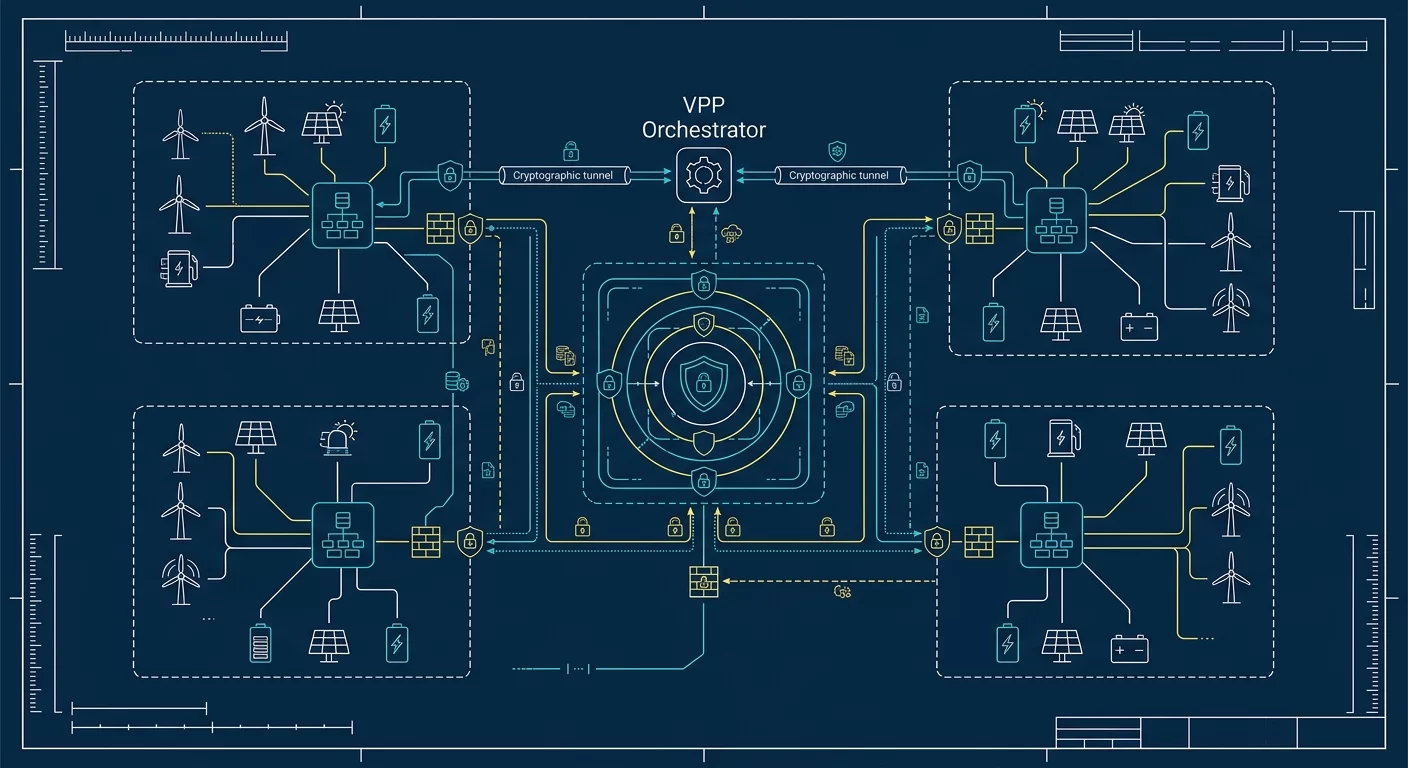
Master the technical complexities of hardening distributed Virtual Power Plant (VPP) control architectures to achieve strict NIS2 compliance and robust OT cyber resilience. This deep-dive case study provides Senior SCADA engineers with actionable frameworks, cryptographic strategies, and code-level implementations for securing critical energy infrastructure.
- 1. The Paradigm Shift: VPPs and the NIS2 Directive
- 2. The Purdue Model Evolution for Distributed Energy
- 3. Deconstructing the VPP Attack Surface
- 4. Comparative Analysis: OT Protocol Security for VPPs
- 5. Hardening the Edge: Cryptographic Controls and mTLS
- 6. Automated Regulatory Reporting and Incident Response
- 7. Architectural Best Practices for NIS2-Ready VPPs
- 8. Conclusion: Engineering Cyber Resilience
1. The Paradigm Shift: VPPs and the NIS2 Directive
The rapid integration of Distributed Energy Resources (DERs) into Virtual Power Plants (VPPs) has fundamentally dismantled the traditional Purdue Model perimeter. Unlike conventional centralized generation, a VPP aggregates geographically dispersed assets—solar inverters, battery energy storage systems (BESS), and microgrids—relying on wide-area networks (WAN) and cloud-edge topologies. This distributed control architecture expands the Operational Technology (OT) attack surface exponentially.
For Senior SCADA Architects operating in the EU or North American entities integrated with European grids, the Network and Information Security (NIS2) Directive mandates a stringent, risk-based approach to cybersecurity. Compliance is no longer an administrative checklist; it requires deep technical controls including zero-trust network access (ZTNA), continuous monitoring, cryptographic data-in-transit protection, and rapid incident response mechanisms.
2. The Purdue Model Evolution for Distributed Energy
In a classical SCADA environment, the Purdue Enterprise Reference Architecture (PERA) provides clear demarcation zones (Levels 0 through 5) separated by robust industrial firewalls and Demilitarized Zones (DMZs). However, VPPs force a compression of these levels at the grid edge. A remote BESS controller effectively houses Level 0 (I/O), Level 1 (PLC/RTU), and Level 2 (Local HMI/Edge Gateway) within a single physical enclosure, communicating directly over cellular or satellite WAN to a Level 3/4 cloud-hosted SCADA master.
This architectural compression requires a shift from perimeter-based defense to asset-centric micro-segmentation. Each DER edge gateway must act as its own security perimeter, enforcing strict ingress/egress firewall rules, deep packet inspection (DPI) for industrial protocols, and hardware-based root of trust. Failure to secure the edge allows threat actors to pivot from a single compromised solar inverter directly into the centralized VPP control room.
3. Deconstructing the VPP Attack Surface
Legacy SCADA protocols such as Modbus TCP and standard DNP3 were engineered for reliability and low latency, not security. In a VPP environment, transmitting unencrypted active power setpoints to a remote BESS over public networks introduces severe vulnerabilities, including Man-in-the-Middle (MitM) attacks, IP spoofing, and malicious replay attacks.
To achieve NIS2 compliance, architects must transition to secure protocol variants and implement intelligent threat detection at the edge. Deploying machine learning algorithms directly on edge computing nodes can identify malicious command injections or anomalous operational behaviors before they are executed by the PLC. For a deep dive into this methodology, refer to our comprehensive guide on Architecting Machine Learning Models for Real-Time Anomaly Detection in High-Availability SCADA Networks.
4. Comparative Analysis: OT Protocol Security for VPPs
Selecting the correct protocol architecture is the foundation of OT cyber resilience. The following table evaluates common SCADA protocols against NIS2 technical requirements for distributed energy environments, highlighting the trade-offs between security and latency overhead.
| Protocol Standard | Encryption (Data in Transit) | Authentication Mechanism | NIS2 Compliance Readiness | Latency Overhead |
|---|---|---|---|---|
| Standard Modbus TCP | None | None | Non-Compliant | Minimal (<5ms) |
| DNP3 (IEEE 1815) | None | None | Non-Compliant | Minimal (<10ms) |
| DNP3-SA (Secure Authentication) | No (Integrity Only) | HMAC Challenge-Response | Partial (Requires TLS wrapper) | Moderate (15-30ms) |
| IEC 60870-5-104 + IEC 62351 | TLS 1.2 / TLS 1.3 | X.509 Certificates | Fully Compliant | High (30-50ms) |
| OPC UA (Secure Profile) | AES-256 / TLS 1.3 | X.509 / User Tokens | Fully Compliant | High (40-60ms) |
5. Hardening the Edge: Cryptographic Controls and mTLS
To secure the telemetry and command channels between the centralized SCADA master and the distributed DER edge gateways, Mutual Transport Layer Security (mTLS) must be enforced. mTLS ensures that both the SCADA master and the edge device cryptographically verify each other’s identities using X.509 certificates before establishing a TCP connection. This mitigates unauthorized rogue devices from joining the VPP network.
Below is an expert-level Python implementation demonstrating a secure edge gateway validation script. This code acts as a middleware layer, intercepting incoming DNP3-over-TCP connections, verifying the client certificate against a trusted Certificate Authority (CA), and enforcing strict cipher suites to comply with NIS2 cryptographic standards.
import ssl
import socket
import logging

# Configure strict logging for NIS2 audit trails
logging.basicConfig(level=logging.INFO, format='%(asctime)s - OT-SEC-EDGE - %(levelname)s - %(message)s')

def create_secure_ot_context(ca_cert_path, server_cert_path, server_key_path):
    """
    Generates a highly restricted SSL context for VPP Edge Gateways.
    Enforces TLS 1.3 and mutual authentication (mTLS).
    """
    context = ssl.SSLContext(ssl.PROTOCOL_TLS_SERVER)

    # Enforce TLS 1.3 only (Deprecate TLS 1.2 for strict compliance)
    context.minimum_version = ssl.TLSVersion.TLSv1_3

    # Require client certificate (mTLS)
    context.verify_mode = ssl.CERT_REQUIRED
    context.load_verify_locations(cafile=ca_cert_path)

    # Load Edge Gateway identity
    context.load_cert_chain(certfile=server_cert_path, keyfile=server_key_path)

    # Restrict cipher suites to strong AEAD ciphers approved by ENISA
    context.set_ciphers('TLS_AES_256_GCM_SHA384:TLS_CHACHA20_POLY1305_SHA256')
    return context

def start_secure_dnp3_listener(host, port, context):
    """
    Binds the secure context to the DNP3 listening port (default 20000).
    """
    bindsocket = socket.socket()
    bindsocket.bind((host, port))
    bindsocket.listen(5)
    logging.info(f"Secure DNP3 Edge Listener active on {host}:{port}")

    while True:
        newsocket, fromaddr = bindsocket.accept()
        logging.info(f"Connection attempt from {fromaddr}")
        try:
            # Wrap socket with mTLS context
            conn = context.wrap_socket(newsocket, server_side=True)
            client_cert = conn.getpeercert()

            # Additional validation: Check Subject Alternative Name (SAN) or specific OID
            if not validate_der_identity(client_cert):
                logging.error(f"Certificate identity validation failed for {fromaddr}. Terminating connection.")
                conn.close()
                continue

            logging.info(f"mTLS established successfully with {fromaddr}. Forwarding to local DNP3 outstation.")
            # Implementation for forwarding payload to local PLC/RTU goes here

        except ssl.SSLError as e:
            logging.error(f"TLS Handshake failed for {fromaddr}: {str(e)}")
        finally:
            pass # Keep listener active for high availability

def validate_der_identity(cert):
    """
    Validates that the connecting entity is a recognized SCADA Master.
    """
    subject = dict(x[0] for x in cert['subject'])
    if subject.get('organizationName') == 'VPP_Grid_Ops' and subject.get('commonName') == 'Primary_SCADA_Master':
        return True
    return False

# Example Execution (Paths are placeholders for actual PKI infrastructure)
# secure_ctx = create_secure_ot_context('/etc/pki/ca.crt', '/etc/pki/edge.crt', '/etc/pki/edge.key')
# start_secure_dnp3_listener('0.0.0.0', 20000, secure_ctx)
6. Automated Regulatory Reporting and Incident Response
A core pillar of the NIS2 directive is the strict timeline for incident reporting—requiring an early warning to competent authorities within 24 hours of a significant cyber threat. Manual log aggregation across a distributed VPP containing thousands of nodes is mathematically insufficient and guarantees compliance failure. SCADA architects must design automated telemetry and security event pipelines that immediately flag unauthorized access attempts, anomalous setpoint changes, or certificate validation failures.
Integrating these security events directly into the SCADA alarm pipeline ensures that OT operators have unified visibility of both process anomalies and cyber threats. By leveraging modern API integrations, security metrics can be formatted into compliance-ready reports automatically. To explore the technical implementation of such automated workflows, review our guide on Architecting Automated Regulatory Reporting Pipelines in GeoSCADA Using C# and the .NET API.
7. Architectural Best Practices for NIS2-Ready VPPs
Beyond protocols and reporting, hardening the VPP architecture requires holistic design principles:
- Zero Trust Network Access (ZTNA): Abandon legacy VPN-based perimeter security. Implement identity-aware proxies for all engineering workstations connecting to remote DERs, ensuring least-privilege access based on cryptographic identity and device posture.
- Hardware Root of Trust: Ensure all edge gateways utilize Trusted Platform Modules (TPM 2.0) to securely store private keys. This prevents physical tampering and key extraction at remote, unstaffed solar or wind sites.
- Continuous Vulnerability Management: Deploy passive OT monitoring tools via SPAN/Mirror ports at major aggregation substations. This allows for real-time asset inventory mapping and the detection of unpatched vulnerabilities without injecting latency or disrupting critical DNP3/IEC 104 traffic.
- Deterministic Network Segmentation: Use Software-Defined Wide Area Networks (SD-WAN) with strict Quality of Service (QoS) to cryptographically isolate control traffic from routine IT, corporate, or maintenance data streams.
8. Conclusion: Engineering Cyber Resilience
Hardening a distributed Virtual Power Plant is not merely an IT network exercise; it is a fundamental OT engineering challenge. As the power grid modernizes, the convergence of high-availability, low-latency control systems with stringent cybersecurity mandates like NIS2 demands a sophisticated, data-driven architectural approach. By transitioning to mTLS-secured protocols, deploying intelligent edge-level micro-segmentation, and automating incident reporting pipelines, Senior SCADA Architects can ensure the continuous, secure, and compliant operation of critical energy infrastructure against an evolving threat landscape.