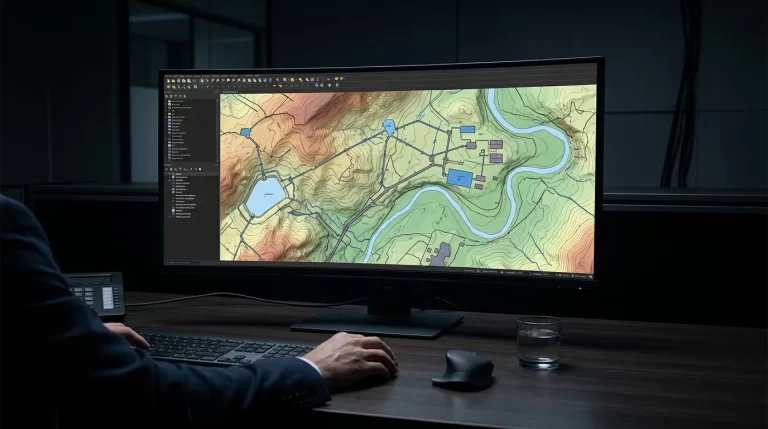
How-To: Advanced QGIS Spatial Data Integration and Topology Mapping for Utility-Scale Power Grids


Discover how to seamlessly integrate advanced QGIS spatial data and perform rigorous topology mapping for utility-scale power grids to enhance SCADA visibility. This deep-dive technical case study explores automated spatial ETL pipelines, Python-based network validation, and real-time geospatial synchronization for high-availability energy infrastructure.
- The Convergence of GIS and SCADA in Modern Power Grids
- The Technical Challenge: Topological Integrity
- Architecting the Integration Pipeline
- Comparison of GIS-SCADA Integration Architectures
- Automating Topology Validation with PyQGIS
- Implementing the SCADA Synchronization Strategy
- 1. Adopting the Common Information Model (CIM)
- 2. Delta Updates vs. Full Reloads
- 3. Regulatory Compliance and Reporting
- Conclusion
The Convergence of GIS and SCADA in Modern Power Grids
For Senior SCADA Engineers managing operations across North America and Europe, the operational paradigm has shifted. Historically, Geographic Information Systems (GIS) and Supervisory Control and Data Acquisition (SCADA) systems existed in isolated silos. GIS managed the static asset inventory, while SCADA handled real-time telemetry. Today, the integration of distributed energy resources (DERs) and the sheer complexity of utility-scale power grids demand a unified, topologically aware operational model. Without a synchronized spatial-temporal view, grid operators risk dispatching field crews to incorrect coordinates, misinterpreting fault locations, and compromising state estimation algorithms.
QGIS, an open-source powerhouse, has emerged as a critical tool for Field Automation Engineers to bridge this gap. By leveraging advanced QGIS spatial data integration, engineering teams can construct deterministic topological models that feed directly into SCADA platforms. This article serves as a practical, expert-level guide to architecting a robust QGIS-to-SCADA pipeline, focusing on topology validation, spatial database integration, and automated data synchronization.
The Technical Challenge: Topological Integrity
In power grid modeling, a map is not merely a visual representation; it is a mathematical graph. Transmission lines (edges) must perfectly intersect with substations, breakers, and transformers (nodes). A visual map might show two lines touching, but at the database level, a gap of millimeters (a “dangle” or “undershoot”) breaks the electrical connectivity model. When this flawed data is ingested by an Advanced Distribution Management System (ADMS) or SCADA, load flow calculations fail.
To prevent these cascading failures, engineers must enforce strict topological rules before data ever reaches the live operational environment. This involves leveraging QGIS to identify and automatically remediate spatial anomalies. Furthermore, integrating these validated models with high-availability SCADA networks ensures that machine learning anomaly detection systems have accurate spatial context when evaluating grid state.
Architecting the Integration Pipeline
The optimal architecture for utility-scale integration avoids point-to-point scripting in favor of a robust Spatial Database Infrastructure (SDI). PostGIS (an extension for PostgreSQL) serves as the authoritative middle-layer. QGIS acts as the topological modeling and validation engine, pushing clean data to PostGIS. The SCADA system then queries PostGIS via standard SQL or an API layer to update its internal one-line diagrams and geospatial displays.
Comparison of GIS-SCADA Integration Architectures
Choosing the right integration method is critical for system performance and maintainability. The table below outlines the primary architectural approaches:
| Architecture Type | Data Flow Mechanism | Latency | Pros | Cons |
|---|---|---|---|---|
| Direct API Integration | GIS server pushes directly to SCADA API via REST/SOAP. | Low (Near Real-Time) | Immediate updates; no middleware required. | High coupling; API rate limits can bottleneck large bulk updates. |
| Spatial Database (PostGIS) | QGIS writes to PostGIS; SCADA polls/subscribes to database views. | Medium (Scheduled/Triggered) | Decoupled; enforces strict data typing; excellent for complex spatial queries. | Requires DBA expertise; introduces an additional infrastructure layer. |
| Flat File Export (CIM/XML) | QGIS exports IEC 61970 CIM XML files for SCADA ingestion. | High (Batch) | Industry standard compliance; highly portable. | Slowest update cycle; difficult to parse incrementally. |
Automating Topology Validation with PyQGIS
Manual validation of thousands of miles of transmission lines is unfeasible. Using PyQGIS (the Python API for QGIS), Field Automation Engineers can script the validation process. The following Python script demonstrates how to automate the detection of topological errors (specifically, dangling lines that do not snap to a substation node) and export the validated dataset to a PostGIS database.
import psycopg2
from qgis.core import (
    QgsProject,
    QgsVectorLayer,
    QgsFeatureRequest,
    QgsGeometry,
    QgsSpatialIndex
)

def validate_and_export_topology(lines_layer_name, nodes_layer_name, db_conn_string):
    # Retrieve layers from the QGIS project
    lines_layer = QgsProject.instance().mapLayersByName(lines_layer_name)[0]
    nodes_layer = QgsProject.instance().mapLayersByName(nodes_layer_name)[0]

    # Build a spatial index for fast node querying
    node_index = QgsSpatialIndex(nodes_layer.getFeatures())

    invalid_features = []
    valid_features = []

    # Tolerance for snapping (e.g., 0.5 meters depending on CRS)
    tolerance = 0.5

    for line in lines_layer.getFeatures():
        geom = line.geometry()
        start_point = geom.vertexAt(0)
        end_point = geom.vertexAt(geom.constGet().vertexCount() - 1)

        # Check if start and end points intersect a node within tolerance
        start_snapped = len(node_index.intersects(start_point.boundingBox().buffered(tolerance))) > 0
        end_snapped = len(node_index.intersects(end_point.boundingBox().buffered(tolerance))) > 0

        if not (start_snapped and end_snapped):
            invalid_features.append(line.id())
        else:
            valid_features.append(line)

    if invalid_features:
        print(f"Topology Error: Found {len(invalid_features)} dangling lines. Fix required before SCADA export.")
        return False

    print("Topology validated successfully. Proceeding to PostGIS export...")

    # Connect to PostGIS and update the SCADA staging table
    try:
        conn = psycopg2.connect(db_conn_string)
        cursor = conn.cursor()

        # Truncate staging table
        cursor.execute("TRUNCATE TABLE scada_gis_staging;")

        # Insert valid features
        insert_query = """
            INSERT INTO scada_gis_staging (asset_id, voltage_kv, geom)
            VALUES (%s, %s, ST_GeomFromText(%s, 4326));
        """

        for feat in valid_features:
            asset_id = feat['asset_id']
            voltage = feat['voltage_kv']
            wkt_geom = feat.geometry().asWkt()
            cursor.execute(insert_query, (asset_id, voltage, wkt_geom))

        conn.commit()
        print("Successfully synchronized QGIS topology to SCADA staging database.")

    except Exception as e:
        print(f"Database error: {e}")
    finally:
        if conn:
            cursor.close()
            conn.close()

# Example execution
# db_string = "dbname='utility_gis' user='scada_admin' host='10.0.0.50' password='secure_pw'"
# validate_and_export_topology('Transmission_Lines', 'Substations', db_string)
Implementing the SCADA Synchronization Strategy
Once the validated spatial data resides in PostGIS, the final step is synchronizing it with the SCADA environment. This requires a deterministic approach to ensure that active alarms and historical telemetry are not orphaned during a geospatial update.
1. Adopting the Common Information Model (CIM)
For seamless interoperability, structure your PostGIS tables to align with the IEC 61970 Common Information Model (CIM). By standardizing asset naming conventions (e.g., using UUIDs for breakers, buses, and transformers), you ensure that the SCADA database can map incoming spatial coordinates to existing tag structures without manual intervention.
2. Delta Updates vs. Full Reloads
Utility-scale grids contain millions of spatial vertices. Performing a full database reload during operational hours can spike CPU loads on the SCADA historian and HMI servers. Instead, utilize database triggers in PostGIS to generate a “Delta Table” that records only inserts, updates, and deletions. The SCADA system can poll this delta table every 5 minutes, applying incremental spatial updates to the operator’s geographic displays.
3. Regulatory Compliance and Reporting
Accurate spatial data is not just an operational necessity; it is a regulatory requirement. NERC CIP and other regional standards often mandate precise documentation of critical infrastructure locations. By centralizing your validated QGIS data, you can easily feed this information into automated regulatory reporting pipelines in GeoSCADA, ensuring that compliance documentation is always perfectly aligned with the live operational state.
Conclusion
Integrating advanced QGIS spatial data into utility-scale SCADA systems is a transformative engineering effort. By moving away from static, disconnected maps and embracing automated, Python-driven topology validation, Field Automation Engineers can build highly resilient, topologically accurate grid models. Leveraging PostGIS as a robust middleware layer ensures that control room operators always have a precise, real-time geographic context for their decision-making. As grid complexity continues to scale with renewable integration, mastering these spatial integration techniques will remain a critical competency for senior SCADA professionals.